This is Leadership?

I’ve already said my piece on the proposed Treasury Bailout of Wall Street, so I won’t belabor that view.

In the meantime, there are much better places to keep up with the minute-by-minute political developments on the proposed bailout — for example, check out Clusterstock, DealBreaker and Felix Salmon for astute and up-to-the-minute analysis.

However, one point from my previous post deserves further review — that is, circumstances such as this provide us with a revealing view of our political leaders.

Do they inspire positive and collaborative action in difficult times for the better good of society?

Or do they attempt to generate support for their political position through fear-mongering and demagoguery?

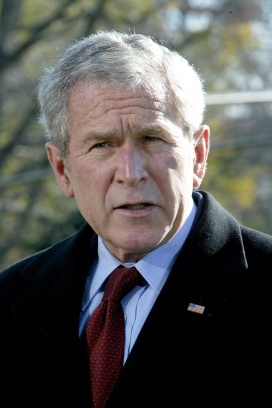
In my view, President Bush’s handling of the negotiations over the proposed bailout has been abysmal. As Jeff Matthews points out:

The President’s unfortunate choice of words—”this sucker could go down”—carry the same deer-in-headlights quality as his televised speech to the American people last week, in which he used the word “panic,” as we recall.

At a minimum, it makes you nervous; at a maximum, it makes you want to throw up first and sell everything second.What happened to the heroic, forward-looking rhetoric great leaders are supposed to provide in times of crisis?

FDR gave us “We have nothing to fear but fear itself.” Churchill gave us “We shall fight on the beaches.” George Bush cruises in with “This sucker could go down.”

We wonder: has a more irresponsible sentence been uttered, by anyone, during this entire crisis?

John Carney reports that President Bush wasn’t any better today in responding to the House’s rejection of the proposed bailout:

“We put forth a plan that was big because we got a big problem,” Bush just said, sitting in a chair placed before a fireplace in the White House. He’s meeting with advisers, he said. “I’m disappointed with the vote in Congress,” the president said.

Was that his version of FDR’s famous fireside chats? Bush looked annoyed he was being bothered with this stuff.

This from a President who failed to persuade more than a third of his own party members in the House for his position in response to a financial emergency?

The Treasury Bailout is Not Rocket Science

The debate over the proposed Treasury bailout of Wall Street firms is coming at a fortuitous time — the election season.

Be wary of any candidates who, after looking appropriately concerned about the dire predictions of the plan’s promoters, throw up their hands and vote in favor of the bailout because “we just have to do something” even if they don’t understand what they are doing.

The fear mongering that the promoters are using to sell the bailout is laughable. This is not rocket science.

For example, when Enron tanked in late 2001, it was the seventh largest public company in the U.S. Enron traded derivatives and other financial instruments with counterparties that were among Wall Street’s biggest commercial and investment banks, which were heavily exposed to its losses. To make matters worse, these investments were concentrated in the energy sector, which is at least as important to the nation’s economy as the housing sector that is at the center of the current crisis.

In short, at the time of its bankruptcy, Enron was one of the nation’s largest publicly-owned companies, a vitally-important market-maker in the natural gas trading industry and a leader in hedging corporate risk through structured finance transactions.

Despite the huge wealth destruction that would result from Enron’s insolvency, not one government or Wall Street leader proposed a bailout of Enron in order to preserve the huge value to the public of the natural gas trading industry and the market for structured finance transactions. And they were right not to do so.

Enron’s bankruptcy proceeded to cause enormous tremors through various industries — particularly the energy industry — because valuable resources for hedging risk of loss had evaporated seemingly overnight. The natural gas trading industry nearly fell apart completely, costing companies and their customers untold billions of dollars that they otherwise could have saved through hedging risk of loss. Similarly, the market for many structured finance transactions dried up, also costing companies another valuable avenue for hedging risk.

However, the nation’s financial system did not break down. Companies adjusted to the changed circumstances and endured their additional costs as best they could. Markets also adjusted. Slowly but surely, both the natural gas trading industry and the market for structured finance transactions rebounded so that both are again providing companies with valuable alternatives for hedging risk and saving money.

Now, the tables are turned on Wall Street. Rather than facing the consequences of their risk-taking decisions in chapter 11, Wall Street’s politically well-connected leaders are weaving their tales of doom for the overall economy to compliant governmental leaders who are only too willing to do their bidding.

In reality, each of these Wall Street firms should be required to endure the same thing that Enron and its creditors did — a chapter 11 reorganization where equity gets wiped out and creditors either take a haircut on payment of their debts or convert their debt to equity in a reorganized firm that emerges from bankruptcy with a cleaned-up balance sheet.

That process ensures that investors and creditors who undertook the risk of investing or dealing with the bankrupt firms share the losses of their risk-taking. Moreover, it allows the firms that really are worth saving (as opposed to simply liquidating) to emerge from bankruptcy with an improved financial condition that should provide the firm with an enhanced opportunity to create wealth again.

What the bailout plan proposes to do is insulate investors and creditors from risk of loss by having the government — funded by taxpayers such as you and me — undertake that risk. There is simply no moral justification for foisting that risk on taxpayers and the only possible practical justification is that sorting all of these firms’ problems out in chapter 11 might take awhile.

But even if the government saw fit to accelerate the Wall Street reorganizations to hedge the risk of a prolonged economic downturn, there is simply no reason for the government to overpay for assets from financially-troubled firms. Rather, the government should simply propose a plan that implements the going-concern liquidation and debt-for-equity reorganization features of chapter 11 on an accelerated basis in return for some reasonable financial contribution to the process. And you can bet that contribution doesn’t need to be close to $700 billion.

Luigi Zingales, the Robert C. Mc Cormack Professor of Entrepreneurship and Finance at the University of Chicago, has written the most cogent piece I’ve seen to date on why the bailout is a bad idea.

Even though it was wrong for the government to contribute to the massive amounts of wealth destruction that resulted from the demonization of Enron, the government was right not to bail out Enron. The circumstances are different now, so perhaps a different approach is more prudent than simply allowing all of these Wall Street companies to be sorted out in chapter 11.

But throwing $700 billion at investors and creditors who should be sharing the losses of their risk-taking is not even close to the best way of doing it.

Update: I couldn’t help but laugh out loud this morning as Warren Buffett and the promoters of the Treasury bailout plan point to Buffett’s sweet $5 billion investment in Goldman Sachs as an endorsement of the plan.

I prefer to look at what Buffett is doing rather than what he is saying.

What he is not doing is what Paulson and Bernanke want the U.S. Treasury to do — buy investment banks’ toxic assets.

Rather, Buffett is buying preferred shares in Goldman with a big yield and warrants to buy Goldman stock at $115 (its trading at over $130) so that he can recover the profit his investment helps foster while Goldman transitions from an investment bank to a bank holding company over the next couple of years.

Meanwhile, Paulson and Bernanke keep promoting their plan to throw $700 billion at whatever trashy assets that Wall Street serves up to them.

It does not engender much confidence that Buffett can cut a far better deal with Wall Street’s best-run investment bank than Paulson and Bernanke propose to cut with the worst-run ones.

Absolutely AIGesque

AIG_recreated Do you recall what we were thinking about three and a half years ago?

That other hurricane

Lehman_Brothers_Holdings So, while the Houston area was enduring a hurricane, the financial markets were enduring one, too.

As with Enron and Bear Stearns, the demise of Lehman Brothers reinforces the inherently fragile nature of a trust-based business (related posts here). 

Larry Ribstein has been insightfully pointing out for years that more regulation of those businesses will not prevent the next meltdown, just as the more stringent regulations added after Enron’s collapse did not prevent Bear Stearns or Lehman Brothers from failing. More responsive forms of business ownership certainly are a hedge to the inherent risk of investment in a trust-based business. Better investor understanding of the wisdom of hedging that risk would help, too.

But as Warren Meyer eloquently wonders, what must Jeff Skilling be thinking about all this? Is Skilling’s inhumane sentence — as well as the barbaric handling of the criminal case against him and other Enron executives — the sacrifice that American society needs to quench its blood thirst to do the same to the leaders of trust-based businesses that suffer the same fate as Enron? I hope not, but  .   .   .

The truth is that Enron — as with Bear and Lehman Brothers — was simply a highly-leveraged, trust-based business with a relatively low credit rating and a booming trading operation that got caught in a liquidity crunch when the markets became spooked by revelations about Andrew Fastow embezzling millions in the volatile months after September 11, 2001.

Fastow’s embezzlement is a crime, but Enron’s demise is not, nor should it be. Beyond the shattered lives and families, the real tragedy here is that an angry  mob convicted Skilling, trumping the rule of law and the dispassionate administration of justice along the way. None of us would be able to survive "in the winds that blow" from the exercise of the government’s overwhelming prosecutorial power in response to the demands of the mob.

I continue to hope that Skilling’s unjust conviction and sentence are reversed on appeal. Not only for his benefit, but for ours.

Hank’s Thank-You Note

Freddie Mac and Fannie Mae_4 Mr. Juggles over at Long or Short Capital passes along this fictional thank-you note from Treasury Secretary Hank Paulson to American taxpayers after this week’s seemingly inevitable federal bailout of Freddie Mac and Fannie Mae (prior posts here):

Dear US Taxpayer,

I would like to congratulate you on your recent purchase. I am glad I was able to convince you that now is the ideal time to offer an uncapped backstop on a $5.2 trillion book of mortgages. We here at the Treasury Dept (along with our sisters over at the Fed), appreciate your repeat business. I am confident that this acquisition will be a profitable one; perhaps even more profitable than your recent purchase of JPMorgan’s Bear Stearns’ liabilities!

Please know that we are actively seeking more deals on which we can work together. I am confident we will find more interesting opportunities before the end of the year.

Yours Truly,
Hank Paulson

Herbert Spencer got it right long ago (H/T Bryan Caplan):

"The ultimate effect of shielding men from the effects of folly, is to fill the world with fools."

The genesis of a mortgage fraud hotspot

Florida Dealbreaker’s essential Opening Bell yesterday included the following note about the connection between the state of Florida and mortgage fraud:

Florida tops 1Q mortgage fraud list (AP)

This is not surprising… Florida is already a key location of the housing bubble. What’s more, Florida tops every fraud list. Hello, Boca Raton? Clearwater? These cities are to fraud what Hungary is to Paprika. It’s an industry. Plus, doesn’t Florida have really lax mortgage/bankruptcy laws as it is?

However, what’s most interesting about Florida is how relatively well the state has turned out given its checkered history. In his fine Throes of Democracy: The American Civil War Era 1829-1877 (HarperCollins 2008) (earlier blog post here), Walter A. McDougall provides the following colorful overview of Florida’s evolution from the epitome of a backwater port:

From the day of the of the pirates to our day of offshore bank accounts, hedonistic resorts, and drug smuggling, Americans have found in the Caribbean an escape from their own laws and morals. The sand spit that Juan Ponce de Leon baptized La Florida was no exception.

Continue reading

Martin Wolf on Capitalism

bill-gates The new Creative Capitalism blog created by Bill Gates, Michael Kinsley and Conor Clarke is quickly making an interesting corner of the blogosphere. Today, Martin Wolf, the associate editor and chief economics commentator at the Financial Times, pens this remarkable blog post about what a company is, and what it is not, under different political systems. In so doing, Wolf provides a an engaging overview of the underlying forces that drive market economies. Read the entire post, but here here is a taste:

First, one has to distinguish the goal of the firm from its role. The role of companies is to provide valuable goods and services – that is to say, outputs worth more than their inputs. The great insight of market economics is that they will do this job best if they are subject to competition. Profit-maximization (or shareholder value maximization, its more sophisticated modern equivalent) is NOT the role of the firm. It is its goal. The goal of profit-maximization drives the firm to fulfill its role.

Second, by creating a competitive market for corporate control, we more or less force companies to maximize shareholder value, or at least behave in ways that the market believes will lead them to do so.   .    .

Continue reading

Criminal Justice?

The always-insightful Larry Ribstein points out that Jamie Olis would have been better off providing material support for Osama Bin Laden than working on the beneficial structured finance transaction that ultimately led to his criminal conviction.

The sad case of Jamie Olis remains one of the most egregious abuses of the government’s prosecutorial power during the post-Enron criminalization of business. The relative lack of outrage over it reflects poorly on all freedom-loving Americans.

Is the problem really risk aversion?

Risk Steve Waldman (H/T Felix Salmon) makes a spot-on observation regarding the conventional wisdom that the current downturn in the financial sector of the global economy is the result of too much risk:

One of the more depressing bits of emerging conventional wisdom is the notion that the financial system took on "too much risk" in recent years. I think it is equally accurate to suggest that the financial system took on too little risk. [.   .   .]

The big central banks, whose investment largely drove the credit boom, were (and still are) seeking safety, not risk. The banks and SIVs that bought up "super-senior AAA" tranches of CDOs were looking for safe assets, not risky assets. We had a housing boom, rather than a Pez dispenser bubble, because housing collateral is (well, was) the preferred raw material for fabricating safe paper. Investors were never enthusiastic about cul-de-sacs and McMansions. They wanted safe assets, never mind what backed ’em, and mortgages are what Wall Street knew how to lipstick into safe assets. The housing boom was born less from inordinate risk-taking than from the unwillingness of investors to take and bear considered risks. Agencies, asset-backed securities, it was all just AAA paper. It was "safe", so who cared what it was funding? [.  .  .]

.   .   . We’ve trained a generation of professionals to forget that investing is precisely the art of taking economic risks, then delivering the goods or eating the losses. The exotica of modern finance is fascinating, and I’ve nothing against any acronym that you care to name. But until owners of capital stop hiding behind cleverness and diversification and take responsibility for the resources they steward, finance will remain a shell game, a tournament in evading responsibility for poor outcomes.

Investors’ childlike demand for safety has made the financial world terribly risky. As we rebuild our broken financial system, we must not pretend that risk can be regulated or innovated away. We must demand that investors choose risks and bear consequences. We need more, and more creative, risk-taking, not false promises of safety that taxpayers will inevitably be called upon to keep.

Read the entire piece here. As noted many times on this blog (most recently here), many powerful forces in our society — the government and the mainstream media to name just two — continue to embrace myths that distract from a mature understanding of the nature of risk.

"It’s all your fault"

Julie Alexandria of the always-clever WallStrip explains how speculators became the latest business villains of the moment. Enjoy.