The Prince of Regulation

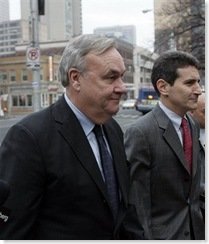
Andrew Cuomo Get a load of the letter that New York Attorney General Andrew Cuomo, the new Prince of Regulation, sent to about ten Wall Street firms the other day:

We believe that the Board of Directors is most appropriately positioned to respond to our requests as the firm’s top management likely has a significant interest in the size of the bonus pools. In this new era of corporate responsibility we are entering, boards of directors must step up to the plate and prevent wasteful expenditures of corporate funds on outsized executive bonuses and other unjustified compensation.

As my Office has told AIG, now that the American taxpayer has provided substantial funds to your firm, the preservation of those funds is a vital obligation of your company. Taxpayers are, in many ways, now like shareholders of your company, and your firm has a responsibility to them.

Accordingly, we also ask that the Board inform us of the policies, procedures, and protections the Board has instituted that will ensure Board review of all such company expenditures going forward. Please provide this Office with an accounting of the actions the Board plans to take that will protect taxpayer funds.

So, Cuomo charts the same political course as Eliot Spitzer before him and Rudy Giuliani before Spitzer. Embrace the Greed Narrative and then sit back and let the mainstream media do the rest. Before you know it, even both major presidential candidates tout the myth that business failure is always about dastardly villains and innocent victims.

My question for Cuomo and his mainstream media minions is quite simple: What is the likely quality of the management and board members who are willing to stick around and put up with Cuomo’s grandstanding?

My bet is that you won’t see many Hank Greenbergs.

Meanwhile, those less-than-stellar management teams all have tickets to feed at the Fed’s money trough.

Ah, the webs we weave.

Different directions

blogosphere1 Newspapers are under siege. This Henry Blodget post reports on the continuing financial deterioration of the New York Times, which looks to be in real trouble.

Meanwhile, the blogosphere continues to thrive. For example, this Stephanie Stradley post about the chronically under-performing Houston Texans defense is far more insightful than anything that I’ve read in years from the cheerleaders, er, I mean, reporters who cover the Texans for the Houston Chronicle, which continues to layoff employees by the droves.

And to think that one of those Chronicle cheerleaders — whose most recent piece is this fawning salute to the manager who was mainly responsible for blowing the 2003 NL Central pennant for the Stros — had the audacity to defame Stradley recently.

Any wonder why newspapers and the blogosphere are going in different directions?

Stossel’s Politically Incorrect Guide to Politics

If you didn’t have the opportunity to watch or record it last Friday, then watch the following six YouTube segments of John Stossel’s Politically Incorrect Guide to Politics when you have the time (the other five segments are below the break). The program is television at its best presenting and analyzing key issues involving government regulation of business and the impact of that regulation on the creation of jobs and wealth. Enjoy:

Continue reading

The shame!

lehman BrothersYou know things are really getting bad in the financial markets when FT.com’s always-lively Dear Lucy column (previous post here) receives the following letter from an investment banker:

"At a dinner party last Saturday I was asked by a fellow guest what I did and I said I was an investment banker. I might as well have said I was a paedophile. Suddenly the whole table – all friends of my wife from the art world – turned on me with such venom I was really taken aback. I tried to defend myself by saying that I had nothing to be ashamed of in the work that I do in M&A, but the more I argued the more hostile the other guests became."

"Next time this happens – and I fear there will be a next time – should I accept guilt for what isn’t my fault, or should I lie and say I’m a librarian?"

Investment banker, male, 42

Among the many entertaining reader comments to the letter were the following:

"Bit surprised you were invited to dinner in the first place."

"Confess and beg for another glass of wine."

"A sensitive investment banker……….. whatever next?"

Refracting Enron Myopia

One of the more entertaining aspects of the current Wall Street financial crisis has been reading how some of the business columnists have been interpreting it.

Take, for example, Houston Chronicle business columnist, Loren Steffy.

You may remember him from his acerbic coverage of the trial of former Enron executives, Jeff Skilling and the late Ken Lay, or his perpetuation of the Enron Myth regardless of the circumstances.

Dismissing me as an Enron apologist, Steffy regularly disputed my long-held theory that the run-on-the-bank that felled Enron could well happen to any trust-based business.

Apparently confused by the fact that what happened to Enron has now happened to Bear Stearns, Freddie and Fannie, Merrill Lynch, Lehman Brothers, AIG and any number of other trust-based businesses impacted by the current credit crunch, Steffy reaches for insight from one of the fellows who set the stage for this mess:

Investigators are poring over the failed firms, looking for signs that executives misled shareholders. Some evidence may be found, but Sam Buell, the former prosecutor who led the effort to indict Enron’s Jeff Skilling, doesn’t think we’ll see widespread prosecutions.

“It’s not a conspiracy if everybody’s in on it,” said Buell, who’s now a law professor at Washington University in St. Louis. “In order to have a fraud conspiracy, you’ve got to have some effort by one group to deceive another group.”

In this case, individual investors may not have understood what Wall Street bankers were doing with complex debt securities, but those charged with safeguarding the marketplace were certainly aware. Regulators knew and approved. So did credit rating agencies. And auditors, both internal and external.

With a mouse click, investors could find public documents that described the debt instruments with hundreds of pages of detail. [.   .   .]

“If everybody’s in a bubble mentality, if they’re betting the price of real estate will keep going up, disclosure doesn’t address the problem of what happens when all those assumptions turn out to be wrong,” Buell said. “Everybody knows what they’re doing. They’re just making bad decisions.”

Yes, you read that correctly. Buell implies that Skilling was guilty of criminal conspiracy because not “everybody” was “in on it” at the time Enron was making its supposedly opaque disclosures. However, since “everybody’s in on it” now, Buell doesn’t think there will be widespread prosecutions because “[i]t’s not a conspiracy if everybody’s in on it.”

With such reasoning, is there any doubt now why this outfit generated this record?

For the record, I actually hope Buell is right this time that few businesspeople are prosecuted for misjudging business risk. But for a more rational explanation of how financial regulation fits into the current crisis, check out these Larry Ribstein posts here, here and here and this masterful one by Arnold Kling.

Stone and the capitalist roaders

Don’t miss Larry Ribstein’s post on Oliver Stone’s financing philosophy in regard to his new movie about George W. Bush — W — the trailer of which is below:

230 years?

So, the Justice Department is seeking a sentence of 230 years for former General Re senior counsel Robert Graham, a 60-year old man who has never been involved in any wrongdoing in his life.

Mercifully, the pre-sentencing report recommends a sentence of “only” 12-17 years.

Graham was convicted earlier this year of securities fraud in connection with his involvement in a finite risk transaction between General Re and AIG that was one of the transactions that led to the downfall of former AIG CEO, Hank Greenberg.

Ironically, AIG is now fighting for its life — even after receiving loans from the Fed in amounts approaching $150 billion — as a result of thousands of transaction decisions that were far more questionable than the one Graham made.

230 years. For involvement in a transaction that was not even clearly improper, much less criminal in nature.

230 years. As a result of a prosecution that required application of the Buffett rule.

230 years. What does that portend for the AIG executives who engaged in this bit of bad judgment? Or those who were involved in this? Did they commit a crime because they breached an obligation to throw in the towel?

This is our government doing such things, folks. It is a reflection of us. And that reflection is not particularly attractive these days.

Say what?

As noted earlier here and here, the lack of leadership involved in the current credit crisis and related Treasury bailout really has been appalling. You don’t think so? Check this out:

Another cost of the bailout

The Doctor is Out As reconsideration of the proposed Treasury Bailout of Wall Street takes center stage in Washington, other pressing and arguably more important problems continue to be ignored.

Take the chronically dysfunctional American health care finance system. This Boston Globe article reports that Massachusetts’ supposedly innovative 2006 health insurance mandate has caused such a shortage of primary care physicians in the state that the wait to see such a doctor has grown to as long as 100 days. In addition, almost half a million citizens are having a difficult time finding a doctor at all:

"There were so many people waiting to get in, it was like opening the floodgates," [Dr. Kate] Atkinson said. "Most of these patients hadn’t seen the doctor in a long time so they had a lot of complicated problems." She closed her practice to new patients again six weeks later. "We literally have 10 calls a day from patients crying and begging," she said.

On the other hand, maybe its better that Congress is distracted from such problems. As a friend of Don Broudreaux observes:

"The one good thing that came out of this whole credit debacle, I now have the perfect pithy response to all the lefties who tell me that the government should take over health care and make it affordable to everyone.  You mean the way they made home ownership affordable to all through Fannie and Freddie?  How did that work out for you?"

Awkward Loan Interview

The proposed Treasury bailout leads to an awkward loan interview: