A Good Football Coach Steps Away from a Coaching Graveyard

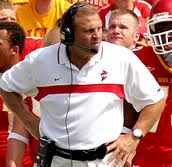
Dan McCarney.jpgDan McCarney, the “dean” of the Big 12 Conference football coaches, resigned under pressure on Wednesday as head football coach at Iowa State University after 12 seasons.

The announcement barely made a blip in the local Houston media, but Coach Mac’s resignation highlighted many aspects of the troubling direction of major college football.

I am biased about Coach McCarney, who is called Coach Mac by most everyone. As regular readers of this blog know, Coach Mac and I have been friends since growing up together in Iowa City, Iowa, where we played together on City High School’s championship football team in 1970.

I moved to Houston with my family shortly after finishing high school and Mac went on to play football at the University of Iowa in Iowa City, but we remained in contact over the years as I went to law school and began a legal career in Houston and Mac went on to the Iowa coaching staff after graduating from undergraduate school.

When Hayden Fry was hired to revive the downtrodden Iowa program in 1979, Coach Mac was one of the only coaches who Coach Fry retained from the previous coaching staff.

As with most of Coach Fry’s personnel decisions, retaining Coach Mac was a good one.

For the following decade, Coach Mac was a part of an extraordinary Iowa coaching staff that not only revived Iowa’s football fortunes, but also produced such outstanding head coaches as Wisconsin’s Barry Alvarez, Oklahoma’s Bob Stoops, Kansas State’s Bill Snyder, Iowa’s Kirk Ferentz and South Florida’s Jim Leavitt.

In 1990, Coach Mac followed Alvarez to Wisconsin, where they took over a 2-9 Badger program and, by 1993, had the team winning the Big Ten Conference championship with a 10-1-1 record, which included a Rose Bowl victory over UCLA.

The next year, Iowa State came calling for Coach Mac and the native Iowan was off to Ames for his first head coaching job.

Over the years, Mac and I have laughed many times about the fact that neither of us really had a clue of what he was getting into at Iowa State. We both knew that the university had long been a coaching graveyard and had eeked out a barely-winning record only a couple of times in the previous 15 years.

Ames is nice little college town, but it is in north central Iowa, pretty much in the middle of nowhere in the opinion of most good college football players. As a result, the football program has always struggled to attract good football prospects, who usually have sexier alternatives to living in central Iowa for four years.

The physical facilities of Iowa State’s football program were poor and the entire football budget at the time was just over $3 million, which was by far the smallest of any public school in the then newly-constituted Big 12 Conference that included such far better-funded programs as Texas, Texas A&M, Oklahoma, and Nebraska, just to name a few.

To make matters worse, Iowa State was a clear second fiddle in the state of Iowa to the University of Iowa, which has a far superior football tradition and an athletic budget more than twice as large as Iowa State’s.

Most folks assume that Kansas State was the toughest head coaching job in the United States before Bill Snyder resurrected it in the 1990’s, but I think a good case can be made that the Iowa State job was even more difficult before Coach Mac took over.

To Mac and Iowa State’s credit, they agreed at the outset that turning Iowa State’s program around was going to be a long-term project. As he did at Iowa and Wisconsin, Mac literally threw himself into the job of rebuilding the Cyclone football program, taking on any speaking engagement and going anywhere to promote Iowa State and its athletic teams.

An outstanding recruiter, Mac and his coaching staff began to expand Iowa State’s traditional Midwestern recruiting base to such football hotbeds as Texas, Florida and California. Mac began to challenge Iowa’s traditional toehold on the best recruits in the state of Iowa.

The progress was slow, though — Mac’s teams lost 42 or their 57 games during his first five seasons.

However, by the 2000 season, Mac and his staff had built a solid foundation for the program. Behind QB Sage Rosenfels (yes, the Texans’ backup QB), Iowa State went 9-3 during that season and won the university’s first post-season bowl game in the university’s 108-year football history (over Pitt in the Insight.com Bowl in Tucson).

That started a 40 game run where Mac’s teams were 25-15, a remarkable feat considering that Iowa State was competing in the brutally-tough Big 12 Conference and playing cross-state rival Iowa each season (Mac’s teams won six of their last nine games against their in-state rival).

By the 2004 and 2005 seasons, Coach Mac had his teams on the cusp of the Big 12 North Division title both seasons only to lose them in an agonizingly close final games in each season.

Nevertheless, after Iowa State had gone to only four bowl games in its history before Coach Mac’s tenure, Mac took the Cyclones to five bowl games in six years, winning two of them. Coming into the 2006 season, optimism was high that the Cyclones would again contend for the Big 12 North Division championship and go to yet another bowl game.

Alas, the 2006 season did not turn out as planned.

First, the Cyclones faced one of the toughest schedules in the country, including an initial stretch of Big 12 games at Texas, at home against Nebraska, at Oklahoma and at home against Texas Tech. Iowa State lost all four and were battered in the process, losing six senior starters to season-ending injury.

Lack of depth is a chronic problem at a place such as Iowa State, so a thin and deflated Cyclone team was smoked over the past two weeks by mediocre Kansas State and Kansas teams. That brought out the “what have you done for me lately” crowd in full force, many of whom were calling on Iowa State to fire Coach Mac despite the fact that few of them have any idea how difficult it is to win consistently at the top levels of major college football.

Suddenly, a little over a year after one of Mac’s best wins as a coach, Mac concluded it was not right for him to become a divisive issue for the university. Understanding Spike Dykes‘ advice that “you lose 10% of your support each season” as a college football coach, Mac understood that he was 20% in the hole at Iowa State based on that formula.

So, Coach Mac elected to resign as head football coach at Iowa State, a difficult job that he would have gladly continued to perform for the rest of his coaching days.

Take a moment to watch his performance during the press conference (click the video camera icon on the left side of the page) to announce his resignation — Mac exudes the class and passion with which he handled all of his duties at Iowa State. In this age of cold-hearted and businesslike coaches who are constantly posturing for the “better” job, it is refreshing to watch someone such as Mac, who wears his big heart and humanity on his sleeve.

Thus, 12 years after arriving at Iowa State, Mac leaves the football program in far better shape than he found it.

The football budget has quadrupled in size under Mac, but it remains the smallest of any public institution in the Big 12 Conference (Texas and A&M’s football budgets are at least 4 to 5 times larger than Iowa State’s). Mac worked behind the scenes continually to improve Iowa State’s facilities and they have improved substantially during his time there.

However, Cyclone athletic department officials are now attempting to raise another $135 million for facilities upgrades in an effort to keep up with the seemingly endless arms race of major college football. In one of the more bizarre aspects of Mac’s resignation, that imminent capital funds campaign was one of the key pressure points that prompted the resignation of the best fundraiser in the history of the Cyclone football program. So it goes in trying to keep up with the Joneses in the wacky world of college football.

After coaching the Iowa State team in its final two games this season, Mac will kick back for a few days, but then I suspect that he will back out looking for another opportunity. His motor is always running and he has a passionate love for coaching. Inasmuch as Mac is widely popular among his fellow coaches, I am confident that he will land on his feet.

However, I am not so sure about Iowa State. The institution is caught in the proverbial rat race of attempting to compete with far-better funded programs and the gap between Iowa State’s resources and those of programs such as Texas and A&M are likely to get even larger. The pressure of that competition has now prompted Iowa State’s administration to take what appears to be a huge risk that the program will decline from the solid foundation that Mac painstakingly built over the past 12 years.

Does Iowa State think that it is going to hire someone who will magically recruit better athletes to Ames than Mac? That’s highly doubtful as Mac is one of the best recruiters in the business and Ames is always going to be a difficult sell to all but a few of the best football prospects.

Does the institution think that it is going to hire someone who will coach better than Mac? Maybe, but Mac is a pretty darn good coach and how many more wins does Iowa State really believe it can achieve through slightly better coaching methods? And even Iowa State officials readily concede that it is highly unlikely that they will ever be able to find someone who can match Mac’s tireless enthusiasm for promoting the institution and the football program.

The bottom line is that seasons such as the one that the Cyclones and Mac are enduring this season are inevitable at a program such as Iowa State’s. That is one of the costs of attempting to compete with limited resources at the highest level of major college football.

That’s not a particularly pleasant reality, but it’s dubious decision-making to take big risks based on an emotional reaction to a disappointing result that is inevitable. That appears to be precisely what Iowa State is doing in letting Mac get away. Wouldn’t embracing a good coach who understands the institution’s limitations and has competed effectively in spite of them be far less risky and much more likely to result in continued success?

Ironically, the Cyclone family now finds itself looking for a new head coach who has the depth and characteristics of . . . well, Dan McCarney. Iowa State will be extremely fortunate if they find one.

Hanging out at Rice University

Rice lovett Hall.jpgRuth Samuelson, an intern with the Houston Press, and a senior at Rice University, reports on David Jovani Vanegas, a 20-year old fellow who showed up about a year ago at Rice as a student and hung out for a year. However, it turns out that he was never actually enrolled at Rice as a student:

On September 13, Rice police arrested Vanegas for criminal trespass. Turns out he wasn’t an actual Rice student but a 20-year-old impersonator. Starting last September, Vanegas began eating in Rice’s dining halls, hanging out with students and attending classes. Some nights, he crashed in friends’ dorm rooms when he was too tired to go home. [. . .]
. . . Within the next few weeks, campus administrators alleged that Vanegas had taken close to $3,700 worth of food from Rice cafeterias. On September 28, the district attorney’s office filed felony charges for aggregate theft. Bail was set at $2,000. [. . .]
So why did Vanegas keep coming day after day for three semesters? He told police officers that he hadn’t gotten into Rice, but it would have broken his mother’s heart for him not to attend. Attempts to reach Vanegas were unsuccessful.

Read about the entire bizarre episode. There is a Marching Owl Band skit in this story somewhere.

The talented Mr. Munitz skates free

munitz14.jpgAlmost lost amidst the media firestorm over California Attorney General Bill Lochyer’s decision to prosecute former Hewlett Packard board chairperson Patricia Dunn was this news item that Lochyer’s office has decided not to sue or prosecute former Getty Trust president and former University of Houston president Barry Munitz (prior posts here).
Lochyer’s office had been investigating Munitz over misuse of trust money for his wifeís travel, using employees for personal errands and making improper payments to a graduate student from trust funds. Lochyer’s office concluded that no legal action was advisable because Munitz’s actions were authorized by the Getty board and that his settlement with the Getty Trust when he resigned exceeded the value of what the state could recover from Munitz in a civil action or a prosecution.
In other words, Lochyer concluded that there was no need to prosecute Munitz because he had done the right thing in settling up with the Getty Trust. That decision in regard to Munitz makes his decision to prosecute Ms. Dunn all the more curious. Perhaps Ms. Dunn should have done lunch with Lochyer?

Politics of academia run amok

Machiavelli.gifMy late father treasured his career in academic medicine, but he did concede that the politics of academia were rather byzantine at times. However, even my father didn’t expect those politics to get this brutal:

The dean of medicine at the University of Texas Medical Branch at Galveston has temporarily stepped down, three weeks after her husband was mugged in the aftermath of announced layoffs at the school.
Dr. Valerie Parisi will “focus her attention on personal and family members” until Oct. 1, said a news release on UTMB’s Web site Wednesday.
Parisi had led reorganization efforts that include layoffs of about 1,000 employees and a change in professors’ salary structure ó moves that have roiled the campus.
Soon thereafter, on July 27, Parisi’s husband, Gary Strong, was attacked by three masked men while walking his dog. One of the men told Strong his wife “doesn’t know who she’s (expletive) with,” leading police to believe the attack may have been related to the layoffs.

Sheesh!

Houston’s ambassador of learning

lienhard.gifOne of the many people that make Houston such a remarkable place is John Lienhard, the longtime University of Houston engineering professor who is the author and voice of the popular KUHF radio series — Engines of our Ingenuity — which is carried across the nation by more than 40 National Public Radio affiliates. As Professor Lienhard describes it, Engines is “a mix of history, engineering and science. The programs describe the machines that make civilization run, and the people who devise them.”
Lienhard recently completed his 2,000th segment of Engines, so the Chronicle’s science writer Eric Berger used the occasion to interview Professor Lienhard. A part of the interview is here, and Eric’s podcast of the entire 30-minute interview is here. The following is Professor Lienhard’s response to Eric’s inquiry as to what he considers the greatest invention:

I don’t like to identify “greatest inventions.” I think inventions flow and swirl and intertwine with one another. There was a wonderful piece by Salman Rushdie where he described stories as flowing like different colors in a great sea, and what you do is dip in and pull out one of those stories. But they’re intermixed and intertwined with other stories. There’s the constant flow and ebb of stories, and the same is true of invention. And there’s another reason. In the book I finally say we’re in trouble when we talk about inventions. The airplane was not an invention. It was something else. I give it a word, multigenium. … They are these accrued inventions that we finally point out and say this is the final thing, like Wright Brothers’ airplane, or Morse’s telegraph, which followed something like 70 years of working with electric telegraphy. We call that thing in a finished form the invention, but it’s not an invention.

Say what?

dutton.jpgAccording to this Chronicle article, State Representative Harold Dutton chose the keynote address at the summer commencement ceremonies of Texas Southern University to declare who is truly responsible for the recent scandal involving former TSU president, Priscilla Slade:

Along with the usual advice and good wishes for graduates, State Rep. Harold Dutton delivered some pointed criticism of Texas Southern University’s Board of Regents during his keynote address at the school’s summer commencement ceremony Saturday.
“You (regents) are directly responsible for the unsuccessful management and government of TSU,” Dutton said in his speech, with the regents arrayed on the platform behind him.
In an interview later, Dutton, D-Houston, said he was referring to the “dark clouds” looming over TSU because of the regents’ handling of the investigation, dismissal and subsequent indictment of former university president Priscilla Slade and their current dispute with the school’s radio station. [. . .]
Dutton, an alumnus of the university, said that although the controversy centered on Slade, he felt that the regents were just as much to blame because it is the board’s responsibility to oversee TSU’s fiscal management. He said the regents acted so poorly he considered them “co-conspirators.”
“I don’t think you just look to Priscilla Slade for the reason why, I think you have to look at all the board members,” he said. “She may be in the spotlight, but I don’t think she’s the only one responsible for the mess we’re in.”

H’mm, let’s see here. The TSU regents hire Slade, who by all accounts did a good job as TSU president, except for that little problem with managing her expense accounts, which is hardly something that regents of a university should be using their time to oversee. Yes, TSU has chronic financial and related management problems, but this and this has a lot more to do with those problems than the efforts of regents who donate their time to deal with the mess.
In short, Representative Duncan, you and the parochial nature of Texas education politics are much more responsible for TSU’s problems than the TSU regents or even Ms. Slade.

The Abbeville Institute’s tribute to Dr. Ross M. Lence

Ross LenceThe late Dr. Ross M. Lence of the University of Houston was a founding member of board of directors of the Abbeville Institute in Atlanta, which is an association of scholars devoted to the critical study of philosophical nature of the Southern tradition in the United States. Upon his death last week, the Abbeville Institute issued the following endearing tribute to Dr. Lence, which — as is always the case in discussing the indomitable Good Doctor — provides several amusing anecdotes, including this classic:

Once at a seminar with other academics, Ross was challenged by an especially obnoxious participant who, rather than confront his arguments, hoped to end the argument by saying that Ross had not read Locke carefully. Ross calmly replied (he was always calm) with that wry smile of his that if the gentlemen would tell us the paragraph number of the Second Treatise that interested him, he would quote it from memory and then attend to what the gentleman thought he had failed to understand in it.

The entire Abbeville Institute tribute is below.

Dear Colleagues, Students, and Friends,

It is with sadness that I inform you that Professor Ross M. Lence died on July 11th, 2006. Ross was a founder of the Abbeville Institute and a member of its Board of Directors. Much of what we stand for was exemplified by his teaching and character.

Ross studied at the University of Chicago, Georgetown University, and the British Museum before completing his Ph.D. at Indiana University under Professor Charles Hyneman. He greatly admired Hyneman who became his mentor and friend. Ross often quoted him and had a portrait of him prominently displayed in his office at the University of Houston over a table set with bottles of whiskey and sherry for the refreshment of his visitors.

Ross tells the story of how, as a raw graduate student, he first met Hyneman. Ross appeared in his office, confronting the abrupt question, what do you want? Ross replied, to study American political science. Hyneman asked, have you seen it? Ross answered, seen what? America, Hyneman replied. If you want to see it, meet me tomorrow morning. They spent the next few summers traveling around America observing its life in small and large towns, villages, and out of the way farming communities.

This story expresses a truth Ross learned from Hyneman and which he embodied in his own work; that theorizing about political things must be rooted in a connoisseur’s understanding of practice. Unhappily this essentially Aristotelian wisdom is missing from much of American political science which has not freed itself from an ideological style of theorizing.

Ross also thought one had to have a detailed knowledge of classical political texts. He could quote Locke’s Second Treatise and The Federalist from memory. Once at a seminar with other academics, Ross was challenged by an especially obnoxious participant who, rather than confront his arguments, hoped to end the argument by saying that Ross had not read Locke carefully. Ross calmly replied (he was always calm) with that wry smile of his that if the gentlemen would tell us the paragraph number of the Second Treatise that interested him, he would quote it from memory and then attend to what the gentleman thought he had failed to understand in it.

His knowledge of political theory and of political things was broad and deep. But he wore his learning lightly. It never intruded pedantically in conversation. It was there as a cultural inheritance which he had worked hard to make his own and from which flowed his disarming Socratic questions; his refusal to accept facile answers even when they favored his own position; his insistence on clarity; and all of this carried on with a wit that was both piercing and lovable.

These qualities made him a great teacher. It is no exaggeration to say that he must be included in a handful of the greatest teachers in the America of our time. He joined the Department of Political Science at the University of Houston in 1971. Over the years he won many teaching awards within and outside the University.

In the late 1990’s hundreds of students established an endowment for a chair in his honor. In 2001 Ross was appointed to the Ross M. Lence Distinguished University Teaching Chair. For over twenty years he regularly taught at the Women’s Institute of Houston. Ross was one of the earliest, and a frequent participant in Liberty Fund Colloquia, a private foundation devoted to exploring the ideal of a society of free and responsible individuals.

He was devoted to “Liberty,” the ideal of an older federative America which today has largely been replaced with talk of “democracy,” and “freedom” both of which typically reduce to “equality.” By liberty he meant the right of individuals and communities of human scale to govern themselves. He lectured at the first Abbeville Institute summer school, 2003, which was recorded on video. So we are fortunate to have a film of his lectures.

Ross was a leading scholar on the philosophy of John C. Calhoun whom he saw as embodying much of what he loved in the ideal of liberty. He edited the Liberty Fund collection of Calhoun’s writings Union and Liberty in 1992. He never published much. Learning for him was inseparable from character, and was a way of life best communicated through face to face knowledge. He not only gave of his time freely to students, he in time acquired an informal reputation at Houston as one to whom students could turn for counsel.

His last year was an ordeal of serious illness and suffering, made more bearable by the great numbers of current and former students and friends who gave their love, respect, and gratitude, and assistance. Few people will leave the world more loved than Ross. And so the Abbeville Institute salutes for the last time our never to be forgotten friend, mentor, and colleague with the words he always used in parting:

Gaudeamus!

Ted Estess eulogizes Ross M. Lence

Ross LenceAs noted in this post from last week on the funeral services for one of Houston’s finest teachers, Dr. Ross M. Lence of the University of Houston, Dr. Ted Estess — Dean of the University of Houston Honors College and one of Ross’ closest friends — gave a superb eulogy during the Requiem Mass for Ross.

Ted has kindly allowed me to post the text of his eulogy (pdf here), the quality of which is surpassed only by Ted’s moving delivery of the eulogy during the funeral mass. Take a moment to read this touching tribute from a dear friend to a teacher’s teacher who has left an indelible mark on Houston:

Farewell to Our Teacher and Friend

I begin with the salutation that Ross himself used most often: Salutem in Domine.

Our teacher and friend Ross Lence was well known and loved for many things: certainly for the clarity and sharpness of his intellect; for the generosity and gaiety of his spirit; for his indefatigable dedication to his students.

In his early years, he was known for the briskness of his step across campus, such that admiring students hurried to keep up; throughout his years, we knew him for the garish colors and shocking patterns of his ties and suspenders.

But perhaps above all, our friend and brother Ross was known and loved for the quickness of his wit; for the merriment and laughter that he bestowed on any gathering, effortlessly, with grace, bite, and kindness.

If his greeting was Salutem in Domine, his farewell was Gaudeamus! Rejoice! Take pleasure in life! Enjoy!

A spirit of hilaritas and felicitas! That is what our friend gave us. That  is what we gladly remember, what we shall sorely miss.

So it is not surprising that every one of Ross’ students has some story to tell. One student received his first paper back from the Good Doctor, only to read this comment: “Young man, if we are going to communicate, we are going to have to settle on a common language. I prefer English.”

This morning, we have no difficulty finding a common language. And I am not speaking of English. What we hold in common — what holds us in common — is gratitude, respect, and affection for Ross himself.

For you see, Ross Lence had an extraordinary capacity to dispose persons in a common direction, and to constitute community. The means by which he did so was conversation; for conversation, practiced with Ross’ wit and generosity, binds persons together. It builds and manifests community.

Anyone who visited Ross in the hospital this past weekend, or anyone who saw him during the year of his illness, witnessed that community. Last evening and again this morning, that community gathered in abundance, present and palpable.

Graybeards from the early 1970’s are taking interest in current Honors students; graduates from the 1980’s are interacting easily with Lencians from the 90’s — all of them, students, faculty, and alumni from four decades, immediately connecting, telling their own stories about their outrageous and beloved teacher and friend.

One Lencian tells of the student who, having been late or absent from class a number of times in the semester, walked up to turn in her final exam. His back turned to her, the Good Doctor was writing something on the board, as she said:

“Dr. Lence, you are a horrible teacher, and I want you to know that because of the way you teach, we haven’t learned a single thing this semester.”

And without so much as turning around, Ross replied:

“Yes, madam, and you are empirical proof of that.”

Circero helps us understand the charisma — the spirited gifts — of Ross Lence when he says, “The essence of friendship consists in the fact that many souls . . . become one.”

The collegial community of friends that arose around Ross Lence owed much, of course, to his own altogether distinctive qualities: his personality was as winsome and energetic and engaging as one is ever apt to find.

Donald Lutz — Ross’ close colleague of thirty-five years and a master teacher himself — got it right when he told me earlier this week, “Every thing that Ross did had a little bit of magic about it. He was a chariot of fire, a visitor from another place, a gift of God.”

Ross was our chariot of fire, our celebrity teacher, the one we showed off, the one whom we sent out to the community, the one in whose radiating light we like to stand, as if to suggest, We are a bit like him ourselves. He was our high star (High Star was the street on which Ross lived in Houston for some thirty years), the one by whom we charted our course and calibrated our compass, pedagogically, intellectually, and morally.

But not always politically. Ross was sometimes — well, often — heard to complain about the state of political affairs in the country he so dearly loved. He would snort, “In America, anything is permitted between and among consenting adults except the shooting of firecrackers.”

Those of you who studied Greek philosophy with Ross certainly learned that we can measure every art, including the art of teaching, by its product. The monument to the artist is what he creates.

If we would see the monument to Ross Lence, we need only look around this morning at the community that he, as artist and midwife, brought into being.

Ross would of course want me to say that he had much help in his life and his work, most notably that of his mother, Nickie. “Big Momma” he sometimes called her. One needs only to meet Nickie to see the source of many of her son’s gifts. Over the years, literally thousands of students came to her house to see her son and to eat her food. They also came for the beer.

Our friend Ross, of course, was a teacher of virtue, a philosopher, a lover of wisdom. But he was, as well, a lover of sights and sounds, and of all things beautiful. His offices at the University were appointed more stylishly than mine and other faculty’s offices. And I have to say it: he was an impulsive shopper. Once he told me, “Ted, the only things I regret are the things I didn’t buy.”

To be sure, not all students took to Ross — some were unhappy because he wouldn’t tell them what they should think. He wouldn’t even tell them what he thought.

Other students were unhappy because Ross was irreverent. He said things that would get any other faculty member fired. He talked about cannibalism and goats, and you were never quite sure why.

He certainly was a trickster. Some students, and probably one or two colleagues and an occasional dean, suspected him of being a diabolical Machiavelli. This made him especially happy.

But in reality, the wellspring of Ross’ irrepressibility, of his merriment and generosity, the ground bass of the songs that he sang, was religious. To him, teaching itself was a religious vocation.

I am speaking of religious in the root sense of the word: re-ligio, a binding together again, as ligaments connect and bind. Ross was bound, first of all, to life itself; to reality and to the structure of the real; but also to country, family, and friends — and to the religious tradition that nurtured him from his mother’s arms to his dying day.

The inclination of Ross Lence toward the religious is evident in words that he wrote several years ago to the parents of an Honors student who had suddenly, and tragically, died. As was his custom when people were in trouble — and Ross did such things an untold number of times over the years — Ross reached out to those parents.

He visited them in their home, attended the funeral service of their son, called them several times, and wrote a note, a portion of which I, in closing, want to share with you. As is often the case with what a teacher says, these words of Ross return now to their source:

How I wish that some faint words of mine could erase the sorrow in your hearts. All of us wish for a little more time to reflect and to love life. But God will never abandon those who love him. I am reminded of the immortal words of Catullus on the death of his own brother: atque in perpetuum, frater, ave atque vale — and so for all eternity, brother, hail and farewell.

“On Teaching” by Ross M. Lence

This has been a weekend of reflection for me as I contemplate the life of one of Houston’s finest teachers — Professor Ross M. Lence (previous post here) of the University of Houston — who died this past week.

Over a hundred former students, colleagues and friends gathered this past Thursday evening to laugh, cry and reminisce about Ross at the visitation, and then those friends and hundreds more gathered on Friday morning for the Requiem Mass for Ross at St. Anne Catholic Church. The mass was profoundly moving, with St. Anne’s soloist Kay Kahl providing beautiful singing and UH Honors College Dean Ted Estess — one of Ross’ best friends and closest colleagues — absolutely hitting the ball out of the park with a poignant eulogy that conveyed perfectly Ross’ extraordinary combination of teaching brilliance, humor and humanity.

A particularly nice touch of the services for Ross was his family’s decision to provide a copy of one of Ross’ essays to everyone who attended. The essay — entitled “On Teaching” — was written by Ross a decade or so ago while collecting his thoughts on teaching in connection with the effort of his former students and friends to raise the funds that eventually endowed the Ross M. Lence Distinguished Teaching Chair at the University of Houston.

Ross never published “On Teaching,” but by passing it along below, I hope that each teacher who happens upon this special essay will take a moment to read and reflect on it, and then use it as inspiration to provide the type of warm, thoughtful and rich mentoring to their students that is Ross Lence’s legacy to his:

I shall not shock anyone, but merely subject myself to good-natured ridicule, if I profess myself inclined to the old way of thinking that the primary concern of teaching and teachers is the student.

While such an observation may seem elementary, it should be noted that for those who define the function of a university as the discovery, preservation, and transmission of knowledge,î the role of teaching (presumably the transmission of knowledge) is formulated in such a way as to avoid mentioning either the teacher or the student. Indeed, when confined to the transmission and preservation of knowledge alone, teaching would seem to be little more than the transmission of decaying sense, entombed in that graveyard of knowledge, the notes of the teacher’s students.

Teaching necessarily involves the highest forms of discovery, the awakening of the students’ minds and souls to the world of creativity and imagination. A good teacher challenges students to join in the continuous, meticulous, and solitary questions of the mind. I myself prefer important questions partially answered to unimportant questions fully answered.

Who could doubt that those students were blessed who witnessed the phenomenal mind of Enrico Fermi as he unleashed the power of the universe on that cold, winter day under the bleachers of Stagg Field at the University of Chicago? There, with only the assistance of a slide rule and his hands, Fermi managed to do what it now takes two computers to replicate: to produce man’s first nuclear reaction.

There, a great teacher, who in the tongue of his native Italy and understood by hardly anyone present, managed to convey to his peers the desperate need to insert the carbon rods into the nuclear mass, thereby saving not only themselves, but the city of Chicago.

No doubt everyone remembers the teacher who most influenced his or her thoughts, person, and soul. No one is perhaps more aware of the best teachers than teachers themselves. That person who most influenced my own thinking was the Sage of Goose Creek, Charles S. Hyneman, Indiana University’s Distinguished Service Professor and President of the American Political Science Association.

That man did for me something that few teachers have ever done for a student. In a desperate effort to teach this kid from the wilds of Montana about the American Regime, Charles Hyneman took me on a 15,000 mile, 5-year trip across America, where he introduced me to every site where an Indian had died, every sausage factory in American and even Alvin, Texas, home of Nolan Ryan.

Today I attempt to lead my students on such a journey of the mind. Some days are good; some days are not so good. But every day I remind myself that teaching is like missionary work, and that I am the messenger, not the message. I constantly strive to bring others to see the excitement, as well as the limits, offered by the life of the mind. I encourage all students to be bold in their thoughts, moderate in their actions, and courageous in their pursuit of truth, wherever it is and however it can be known.

As I now come to my own golden age, I often think of my teacher. Of his incredible kindness, his depth of soul, and the power of his imagination. My real hope is that I, too, will be remembered by those who come after me with the same fondness.

This, then, is my philosophy of teaching: teachers love their own teachers, and they are loved in turn.

Ross M. Lence
Houston, Texas

Update: Ted Estess eulogized Ross and the Abbeville Institute provides a touching tribute.

Agency costs of big-time college football

auburn.tigers.jpgCollege football is a big and competitive business, so it’s no surprise that the issue of agency costs has reared its head with frequency over the past century of the sport. This NY Times article reports on the latest incident of apparent academic fraud — an Auburn University sociology professor arranged to have 18 members of the 2004 Auburn football team, which went undefeated and finished No. 2 in the nation, take a combined 97 hours of the “directed-reading courses” which required no classroom instruction whatsoever. More than a quarter of the students in the professor’s directed-reading courses were Auburn University athletes. The usual NCAA investigation is to follow while serious academics at Auburn must be shaking their heads over it all.
As noted in this previous post, big-time college football and basketball are caught in a vicious cycle of uneven growth, feckless leadership from many university presidents and obsolescent business models. As the previous post notes, it’s an unfortunate situation because big-time college football and basketball would likely not suffer a bit from reform that required universities to compete with true student-athletes, as opposed to minor league professional players. Given the hyprocrisy of many state universities subsidizing minor league football and basketball at the same time as grappling with funding issues for core academic programs, one would think that expensive and mostly unprofitable system of big-time college football and basketball would be ripe for reform. However, powerful and wealthy special interests continue to support the current system despite the implications to the universities’ academic responsibilities.
Is there any hope for true reform of intercollegiate athletics as well as minor league football and basketball? Or is the current system so entrenched in concentrated wealth and regulation that it is impervious to reform?