I thought what occurred to the football after the punt in the video below only happened to my golf shots on soggy courses. I guess that’s what you get from re-sodding a football field immediately before a several-inch deluge:
Category Archives: Sports – Football
Todd Graham’s Inferno
Rice University gave Todd Graham his first opportunity to be a head coach of a college football program. And Graham was quite successful in his only season on South Main, leading the Owls to their first bowl game since the early 1960’s.
But Graham’s stay on South Main was anything but platonic. After being named Conference USA Coach of the Year and renegotiating his contract with Rice, Graham announced a couple of weeks after the bowl game that he was leaving to replace his former boss as head coach at the University of Tulsa. By virtually all accounts, Graham handled the job change about as badly as possible.
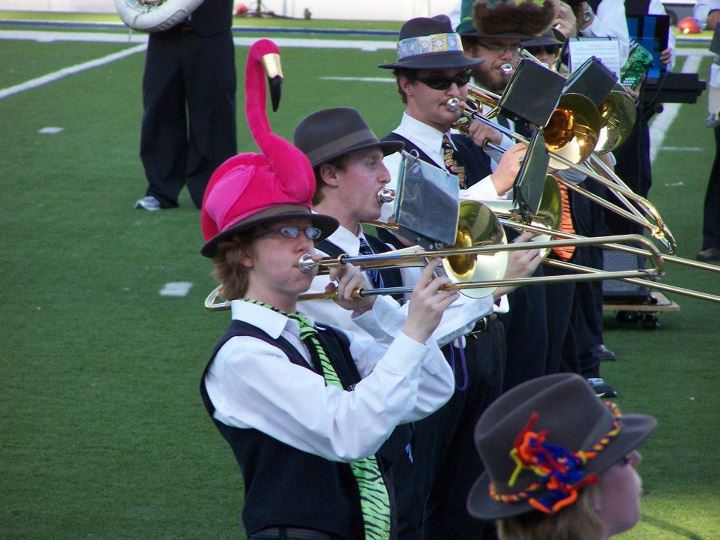
Well, as predicted in my post at the time of Graham’s job change, it was just a matter of time before Rice’s notorious Marching Owl Band (“the MOB”) would have an opportunity to comment on Coach Graham’s antics, and that opportunity presented itself this past Saturday during halftime of the Rice-Tulsa game at Rice Stadium. The MOB performed a halftime show entitled “Todd Graham’s Inferno,” which concluded with the following comment over the stadium public address system:
Childish for sure, but nothing out of the ordinary for the MOB. And it was certainly not even as clever as the MOB’s theme for their halftime show during Rice’s bowl game against Troy last year — “Troy Loses. Read Homer”
So, how did the University of Tulsa respond? By doing precisely what the MOB probably wanted — fueled the inferno by filing a complaint against the MOB with the C-USA commissioner:
The University of Tulsa has sent a formal complaint to Conference USA regarding Rice’s halftime show during the Golden Hurricane-Owls football game on Saturday.
The performance by the Rice marching band was titled “Todd Graham’s Inferno” and depicted a search for the former Owls coach through different circles of Hell, based on Dante’s “Divine Comedy.”
After taking numerous jabs at Graham, the show ended by calling the Tulsa coach a “d—–bag” over the public address system.
“We filed a formal complaint with the conference and that’s where it stands now,” TU athletic director Bubba Cunningham said.[. . .]
When asked what he wanted the complaint to accomplish, Cunningham said, “We need to provide an environment where a student-athlete can participate and fans can enjoy college athletics in a very positive way.”
Sportsmanship has been a point of emphasis in C-USA, the Tulsa athletic director said. “When we don’t meet those standards, we need to look at ourselves as a league and find how we can make that experience better,” he said.
Yeah, that was real sportsmanship displayed by Cunningham and Tulsa last year when they lured Graham away from Rice right in the middle of recruiting season.
At any rate, all of this provides the opportunity to pass along again the following anecdote about football coaches that legendary Houston sportswriter Mickey Herskowitz tells:
In the mid-1960’s, the Los Angeles Rams had hired George Allen off of the coaching staff of George Halas in Chicago.
Halas was furious that the Rams failed to ask for his permission and threatened to take Allen to court. At a league meeting after the issue was resolved, Halas used the occasion to vent his anger at his former defensive coach.
“George Allen,” Halas raged, “is a man with no conscience. He is dishonest, deceptive, ruthless, consumed with his own ambition.”
At that point, Vince Lombardi leaned over to the owner of the Rams and whispered:
“Sounds to me like you’ve got yourself a helluva football coach.”

The Sherman hiring
Well, Texas A&M Athletic Director Bill Byrne’s “nationwide search” for a new head coach to replace Dennis Franchione took a couple of days and extended all of about 100 miles southeast of College Station as A&M hired Houston Texans assistant head coach Mike Sherman as its new head coach yesterday. The deal is for seven years at $1.8 million per year. Ryan over at TAMaBINPO has a nice overview of Sherman’s coaching career.
Although some in the Aggie nation were disappointed that A&M didn’t hire a “big-name” coach de jour, my sense is that hiring Sherman is a reasonably good move. A&M is currently in the latter stages of a somewhat divisive search for a new president, so the A&M Board of Regents doesn’t need more faculty flak from another flank. Moreover, A&M overpaid badly to hire Franchione, so the buyout of Coach Fran’s contract is going to be expensive, even by A&M standards. Under these circumstances, eschewing a high-priced, big-name coach is certainly understandable.
Within the coaching profession, Sherman has an excellent reputation as a hand’s-on coach, which frankly Franchione did not have when A&M hired him. The only negative comment that I’ve heard about Sherman is that he was not a particularly good evaluator of talent as Green Bay’s general manager from 2001-04. That trait has certainly reared its head during his stint with the Texans — Sherman was among those who blessed the questionable decision to pick up an expensive option to keep former Texans QB David Carr around for another year and he lobbied hard for the Texans to overpay old and injured RB Ahman Green. Those two decisions are costing the Texans big-time in terms of salary cap space.
Nevertheless, Sherman will have plenty of assistance in picking talent for A&M’s football program and he inherits one of the richest bases for recruiting good football players in the U.S. The initial problem that Sherman faces in the recruiting wars is that three Big 12 South programs — Oklahoma, Texas and Texas Tech — have been clearly superior to the Aggies’ program for a prolonged period now, although the reasons for each program’s superiority are different. UT and OU have had better overall talent than A&M, while Tech has simply outcoached A&M while deploying comparable talent.
At this point, the OU and Texas programs are two of the select few big-time college football programs that are recruiting almost entirely high school prospects who project to have the potential to develop into players capable of playing in the National Football League. A&M does not yet have that luxury in recruiting players into its program, so Sherman will be dealing with a talent deficit to programs like OU and UT for at least the first 2-3 years of his tenure at A&M. With the exception of A&M’s last two victories over UT, Franchione’s A&M teams did not generally compete well against teams that had superior talent. How Sherman’s teams deal with that talent deficit during his initial A&M seasons will largely determine whether Sherman succeeds or fails in Aggieland.
2007 Weekly local football review
(Jay Janner/Austin American photo; previous weekly reviews here)
Texas Aggies 38 Texas Longhorns 30
For the second straight year, the Aggies (7-5/4-4) upset the Longhorns (9-3/5-3), this time as a resignation present for Aggie head coach Dennis Franchione. I trust that dirty look that Franchione gave to A&M athletic director Bill Byrne at the post-game press conference when he announced his resignation is an indication of how buy-out negotiations have gone. A&M officials have scheduled a news conference for 11 a.m. today to introduce Texans offensive coordinator Mike Sherman as the Aggies’ new head football coach while hoping that Aggie fans didn’t notice the Texans’ offensive gameplan in yesterday’s game (see below).
At any rate, the Aggies dominated this game as the porous Longhorns defense made A&M QB Stephen McGee look like Joe Montana, and that’s really hard to do. But the irony of the victory is that the Ags gameplan was precisely what A&M fans thought they were getting when A&M hired Franchione five years ago — diverse offensive production, forcing turnovers, creating big plays, exciting trick plays and consistent wins over top tier teams of the Big 12. Unfortunately, this second straight win over the Longhorns came way too late for Coach Fran.
Meanwhile, almost as interesting as the Aggies’ coaching search is the quandry that faces Longhorn coach Mack Brown. With the defeat, the Horns have now lost to Texas A&M and Oklahoma in the same season for the first time since 1993. The Horns have also lost two straight games to unranked and underachieving Aggie teams and have squandered BCS bowl berths in two consecutive seasons. And that’s even after the Horns played one of the their easiest schedules in recent history.
However, most troubling for the Horns is a defense — and even more precisely, a pass defense — that has plummeted over the past year far below UT standards. As noted above, the Horns defense made McGee, who is a mediocre college QB, look like an NFL prospect while throwing for 362 yards. And that was not particularly unusual, either. Against a weak schedule, the Horns defense gave up an average of 533 yards in its final three games, gave up 28 points or more in half of their games as well as 35 points per game over their last four. My sense is that Coach Brown will be taking a hard look at whether staff changes are in order this off-season.
The Aggies and Longhorns now await bowl assignments, although it appears likely that the Aggies will meet Michigan or Penn State in San Antonio’s Alamo Bowl. The Longhorns are probably ticketed for yet another appearance in the Holiday Bowl, which was their typical destination before the now fading-in-memory 2005 National Championship.
I’m not making this up. After the Texans’ (5-6) recent two game winning “streak,” the Texans’ cheerleaders in the local mainstream media were actually mentioning the word “playoff” in their media pieces. Then, the Texans in this game proceed to score one TD in the first 57 minutes against the NFL’s worst defense, convert only two third-downs all game, and commit three turnovers, giving the team 29 on the season, four more than last season’s 6-10 team. Message to local mainstream media — the words “playoffs” and “Ron Dayne, starting running back” are incompatible. It would also be nice if the Texans defense didn’t make the Browns’ (7-4) RB Jamal Lewis look like he had just become five years younger. The Texans travel to Nashville next Sunday to face Vince Young and the fading Titans (6-5) before returning home for three of their last four games of the season.
The feisty Owls (3-9/3-5) made a game of it, but ultimately simply did not have the horses to stop Tulsa (9-3/6-2) and win the Todd Graham Revenge Bowl. It would have been a nice victory for the Owls and the Houston Cougars, who would have won the C-USA West Division for the second straight year if Tulsa lost. But Rice returns its offensive nucleus of QB Chase Clement, WR Jaret Dillard and HB James Casey, so next season’s Owls will still be able to score some points. Now, if they could just find someone to tackle . . .
Houston Cougars 59 Texas Southern 6
Remind me again — why was this game scheduled? It seemed absolutely appropriate that the game ended up being played in a mush pit caused by a cold, driving rainstorm. The Cougars (8-4/6-2) have accepted a Texas Bowl berth at Reliant Stadium on December 28th against probably a Big 12 team, either Oklahoma State (6-6/4-4) or Colorado (6-6/4-4). If the Big 12 qualifies two teams for BCS bowls, then the Coogs will play an at-large opponent such as TCU (7-5/4-4).
The 2007 UT-A&M Game
Although the 113 year-old rivalry game between the Texas Longhorns and the Texas A&M Aggies is always interesting, this year’s edition at 2:30 p.m., CST today in College Station (ABC) has an added element of intrigue over the typical UT-AM slugfest.
First, just a season removed from arguably saving his job by guiding the Ags to an upset of the Horns in Austin, embattled A&M head coach Dennis Franchione will almost certainly be coaching his final game for the Aggies. Franchione did not fit in at Aggieland and never seemed capable of winning big games consistently — his Aggie team followed up that big win over the Horns last year with a humiliating 45-10 loss to Cal in the Holiday Bowl. You never know what to expect from players who are playing their final game for their coach. Could be good, could be bad.
Second, the 13th-ranked Horns (9-2/5-2) need a win if they are going to keep their slim BCS Bowl game hopes alive. With a win and an Oklahoma loss on Saturday against Oklahoma State, the Horns would win the Big 12 South division and play either Missouri or Kansas in the Big 12 title game in San Antonio on December 1st. But a loss to the Ags not only would end those hopes, it would earmark the Longhorns to a middle-tier bowl game for the second straight season.
The Horns are a 5 1/2 point favorite, but there really is not much difference between the two teams this season. Texas throws the ball more effectively than A&M, but that’s not saying much because the Aggies act as if the forward pass is a new-fangled innovation that cannot be perfected until some uncertain date in the future. Both teams run the ball with about equal effectiveness and neither team’s defense has been particularly dominant. Although the Horns have reeled off five straight wins since their loss to Oklahoma, the wins came over teams with a combined conference record of 12-26.
The Horns have dominated the series with an overall record of 73-35-5 record, but that record is a bit deceptive, particularly with regard to how close the series has been in recent decades. If you back out the Horns’ dominant 31-3-1 record during the period from 1940 through 1974 when A&M was being transformed from a small, male-only military institution into a large, co-educational state university similar to UT, the record is a more balanced 42-32-4. In fact, since 1975, the Aggies actually lead the series 17-15.
Finally, for once, the UT-A&M game will not be the biggest game in the Big 12 this weekend. That moniker goes to the Border War showdown on Saturday night in Kansas City between no. 2 Kansas (11-0/7-0) and no. 4 Missouri (10-1/6-1). Take a moment to read this fine Joe Posnanski column on KU head coach Mark Mangino, a fellow for whom it is really easy to cheer.
Lubbock is just a tough place, period
As this earlier post notes, Lubbock — the home of the Texas Tech Red Raiders — is a tough place to play for visiting college football teams.
But the video below shows that Lubbock is also a tough place for at least a couple of the hundreds of excited Tech fans who rushed the field after Tech’s Saturday night victory over fourth-ranked Oklahoma.
What on earth are these police officers thinking?
2007 Weekly local football review
(AP Photo/Dave Einsel; previous weekly reviews here)
Texans 23 Saints 10
The Texans (5-5) enjoyed the return from their bye week with a convincing win over the Saints (4-6), who appear to be a shadow of the team that played in the NFC Championship Game last season. QB Matt Schaub (21/33 for 293 yds, 2 TD’s, no ints), who had his best game as a Texan, and previously injured star WR Andre Johnson (6 rec, 120 yds, 1 TD (73)) were particularly effective, while the Texans defense led by DE Mario Williams and an undermanned but feisty secondary kept the Saints’ offense off-rhythm for much of the game. The Texans go on the road over the next two weeks for games against the Browns (6-4) and the Titans (6-3) before returning home for three of the season’s last four games.
Houston Cougars 35 Marshall 28
The Cougars (7-4/6-2) kept their fleeting Conference USA title hopes alive with a close win over Marshall (2-9/2-5) as the potent Houston offense came alive in the 2nd half after taking a long nap during the debacle last week against Tulsa and during the first half of this game. The Coogs finish up their regular season with a non-conference game next Saturday against hapless Division I-AA Texas Southern (0-10) while awaiting the outcome of Rice’s grudge match against Tulsa at Rice Stadium. If the Owls can pull off the upset against Tulsa, then the Coogs win the CUSA West division title and advance to the conference championship game on December 1st against Central Florida.
The Owls (3-8/3-4) modest three game winning streak came to an end as Tulane RB Matt Forde rolled up 194 yards and 5 TD’s against Rice’s overwhelmed defense. Rice’s Chase Clement was 35-of-55 passing for 353 yards and four touchdowns, and — with 379 total yards — set a Rice season record for total offense with 3,319 yards. The Owls could do a big favor for their cross-town rival Cougars by upsetting Tulsa (8-3/5-2) in the Todd Graham Grudge Match next Saturday at Rice Stadium. However, without a meaningful defense, the Owls offense will probably have to put 60 points on the board against Tulsa for Rice to have a chance to win the game.
Texas (9-2/5-2) and Texas A&M (6-5/3-4) were idle this weekend as they prepare for their annual Friday afternoon (2:30 p.m./ABC) game, which has taken on added importance with Oklahoma’s (9-2/5-2) loss to Texas Tech (8-4/4/4) on Saturday night. If the Horns beat the Aggies and a beat-up OU loses to Oklahoma State (6-5/4-3) next Saturday, then the Longhorns will win the Big 12 South Division and represent the division in the Big 12 championship game in San Antonio on December 1st.
And finally, in another type of football, the Houston Dynamo won its second straight Major League Soccer Cup Title, defeating the New England Revolution 2-1. The Dynamo are the first team to win back-to-back MLS Cups since D.C. United did so in 1996-97. The Dynamo will celebrate their latest championship on Tuesday at Houston City Hall from 5:30-7:30 p.m.
Mike Leach’s Selective Memory
By now, most folks who follow college football know that Texas Tech head coach Mike Leach received a record fine and public reprimand from the Big 12 Conference for his post-game comments questioning the integrity of the referees who officiated last weekend’s Texas-Texas Tech game in Austin in which the Horns hammered the Red Raiders, 59-43.
But not as well publicized as Leach’s outburst is Leach’s hypocrisy in making the remarks in the first place.
One of Leach’s main gripes with the officiating crew last weekend was that one of the officials on the crew was from Austin, referee Randy Christal. However, what Leach failed to mention is that the last two Tech-Texas games also have had a Lubbock resident as an on-field crew member — Tim Pringle last year in Lubbock and Kelly Deterding this past weekend in Austin.
Moreover, this week’s Tech-Oklahoma game in Lubbock renews a similar controversy after the controversial ending of the 2005 Tech-OU game in Lubbock, but Leach wasn’t complaining about the referees after that game.
Both Lubbock resident Deterding and Austin resident Christal were on the officiating crew during that 2005 game when the officials flagrantly missed a spot on a key fourth down play that kept a last ditch Tech drive alive and then allowed Tech to win the game on a disputed Taurean Henderson touchdown run on the final play of the game.
The video of the blown spot call that kept the final Tech drive alive is below.
It’s 4th down and 3, Tech QB Cody Hodges’ pass is batted in the air and Tech WR Danny Amendola and an OU defender come down with the ball well-short of the first down mark. After the play, both television announcers observe that, even if Amendola caught the ball cleanly, he was stopped well short of the first down marker. The announcers are incredulous when the officiating crew spots the ball and gives Tech a first down:
Of course, that play is followed by the last play of the game where the video shows Tech RB Henderson s-t-r-e-t-c-h-e-s the ball over the goal line. At least Henderson’s TD stretch was a closer call than the Amendola “phantom first down” catch.
To his credit, Oklahoma head coach Bob Stoops didn’t make a public issue of it at the time even though he had a better case than Leach did after his recent outburst in Austin. Stoops’ maturity is one of the many reasons that he is a better and more successful coach than Leach.
By the way, that controversial 2005 Tech-OU is also famous for the following video, which establishes that Lubbock is not only one of the toughest places for a visiting team to play, but also one of the toughest places for a visiting player to give a post-game press interview:
Update: Tech upset the Sooners, 34-27.
Vince Young’s $5 million donation to UT
Michael Lewis (previous posts here) — author of Moneyball and The Blind Side: Evolution of a Game (previous post here) — pens this NY Times op-ed in which he addresses a frequent topic on this blog — that is, the shameful economic exploitation of athletes by many universities in the business of big-time college football (see previous posts here, here and here):
College footballís best trick play is its pretense that it has nothing to do with money, that itís simply an extension of the universityís mission to educate its students. Were the public to view college football as mainly a business, it might start asking questions. For instance: why are these enterprises that have nothing to do with education and everything to do with profits exempt from paying taxes? Or why donít they pay their employees?
This is maybe the oddest aspect of the college football business. Everyone associated with it is getting rich except the people whose labor creates the value. At this moment there are thousands of big-time college football players, many of whom are black and poor. They perform for the intense pleasure of millions of rabid college football fans, many of whom are rich and white. The worldís most enthusiastic racially integrated marketplace is waiting to happen. [. . .]
If the N.C.A.A. genuinely wanted to take the money out of college football itíd make the tickets free and broadcast the games on public television and set limits on how much universities could pay head coaches. But the N.C.A.A. confines its anti-market strictures to the players ó and God help the interior lineman who is caught breaking them. Each year some player who grew up with nothing is tempted by a boosterís offer of a car, or some cash, and is never heard from again. [. . .]
Last year the average N.F.L. team had revenue of about $200 million and ran payrolls of roughly $130 million: 60 percent to 70 percent of a teamís revenues, therefore, go directly to the players. Thereís no reason those numbers would be any lower on a college football team ó and thereís some reason to think theyíd be higher. Itís easy to imagine the Universities of Alabama ($44 million in revenue), Michigan ($50 million), Georgia ($59 million) and many others paying the players even more than they take in directly from their football operations, just to keep school spirit flowing. (Go Dawgs!)
But letís keep it conservative. In 2005, the 121 Division 1-A football teams generated $1.8 billion for their colleges. If the colleges paid out 65 percent of their revenues to the players, the annual college football payroll would come to $1.17 billion. A college football team has 85 scholarship players while an N.F.L. roster has only 53, and so the money might be distributed a bit differently. [. . .]
A star quarterback, . . . might command as much as 8 percent of his college teamís revenues. For instance, in 2005 the Texas Longhorns would have paid Vince Young roughly $5 million for the season. In quarterbacking the Longhorns free of charge, Young, in effect, was making a donation to the university of $5 million a year ó and also, by putting his health on the line, taking a huge career risk.
Perhaps he would have made this great gift on his own. The point is that Vince Young, as the creator of the economic value, should have had the power to choose what to do with it. Once the market is up and running players who want to go to enjoy the pure amateur experience can continue to play for free.
Read the entire piece.
UT’s Sooner legacy
This post from earlier this fall noted that this season was the 50th anniversary of the legendary University of Texas football coach Darrell K. Royal (previous posts here) taking the reins of the then faltering Longhorn football program and turning it into one of the most successful programs in the country over the next 20 years. If you are interested in this fascinating man, then don’t miss this excellent Wann Smith article on Coach Royal, which passes along the story of why Coach Royal elected not to return to his alma mater (the University of Oklahoma) after the 1963 season when famed OU coach Bud Wilkenson finally stepped down:
After Bud Wilkinson resigned following the 1963 season, there was a groundswell of support for the idea of bringing Darrell Royal back across the Red River. Royal was inundated by calls from old schoolmates and friends urging him to take the OU job.
But Royal wasn’t interested in returning to his home state. He had made it clear from the start that he had no interest in the Oklahoma coaching vacancy. However Royal’s decision to stay in Austin had nothing to do with any enmity for either the State of Okahoma or for his Alma Mater.
“I had been searching for something,” said Royal. “And I found it in Texas. . .”
Read the entire article.