As the Aggie Football World Turns

Franchione OUWhat is it about Texas A&M University that the institution cannot fire a football coach correctly?

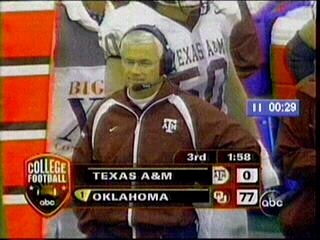
The slowly disintegrating status of A&M head football coach Dennis Franchione has been a frequent topic on this blog for almost two years now. Although yesterday’s development in the saga was bizarre — A&M Athletic Director Bill Byrne holding a press conference to announce in the middle of the football season essentially that Coach Fran is kaput as A&M’s head coach after this season — it was not particularly unusual in view of A&M’s rather dubious tradition in dealing with its football coaches.

Take what happened in 1978, for example.

A&M head coach Emory Bellard, the originator of the Wishbone offense while serving as Darrell Royal’s offensive coordinator at Texas in the late 1960’s, had been hired by A&M in 1972 to resurrect the floundering Aggie football program.

By the 1978 season, Bellard had led the Aggies to three straight bowl games and the Aggies seemed poised to become a national power that season.

By week five of the 1978 season, Bellard’s Aggies were rolling at 4-0 and were rated no. 6 in the Associated Press Top 20 poll.

Bellard was reaching the pinnacle of his popularity at A&M as the Ags prepared to face Houston, which had not been particularly impressive and had lost in their first game of the season to a Memphis State team that the Ags had crushed at home 58-0 a couple of weeks earlier. Moreover, the week before, the Coogs had barely beaten winless Baylor, 20-18.

Thousands of Aggies descended on Houston’s Astrodome fully expecting the Aggies to continue their winning ways over the underdog Cougars.

Unfortunately for the Ags, Houston head coach Bill Yeoman, one of the brightest and most creative college football coaches of his time, had put together a brilliant game plan for this particular game.

Taking advantage of the Aggies unbridled over-aggressiveness, Yeoman devised a series of traps, draw plays and screen passes to supplement his famous Veer option attack that utterly befuddled the Aggies. In the meantime, an aroused Cougar defense stuffed the vaunted Aggie Wishbone and never allowed it to get untracked.

By halftime, the unranked Cougars led the no. 6 team in the country 33-0 and the large Aggie contingent in the Astrodome was absolutely stunned. Neither team scored in the 2nd half and the game ended, Houston 33 Texas A&M 0.

Back in those days, most head coaches supplemented their salaries by conducting a show the day after the game in which they went over the film highlights of the previous game. Bellard’s show the Sunday after the Houston upset was absolutely brutal.

Bellard addressed the camera by himself with no studio host to toss him some softball questions to defuse the anxiety of the humbling defeat. With literally no highlights of Aggie plays from the debacle, Coach Bellard was left to reviewing various Houston highlights from the game and explaining what the Aggie players did wrong in allowing the Cougar players to perform such feats. Coach Bellard looked haggard and utterly demoralized.

After watching the show with me, my late father turned to me and observed: “I hope Mrs. Bellard has removed all guns and sharp objects from their home for awhile.”

At any rate, the Ags dropped to no. 12 after the Houston game and began preparations for their next game against an 0-5 Baylor team that had played one of the toughest schedules in the country.

In arguably one of the worst games in the history of Kyle Field, that winless Baylor squad hammered the listless Aggies 24-6, as a previously unheralded freshman running back named Walter Abercrombie ran over and through the Aggies for 207 yards.

In the span of two weeks, what had been the no. 6 team in the land had been outscored 57-6.

Coach Bellard resigned the next day under intense pressure (one large sign hanging from an A&M dorm window at the time urged “Make Emory a Memory”).

In only two weeks, he had gone from being the King of Aggieland to quitting the job that he had always coveted.

To this day, Bellard’s demise and Texas A&M’s reaction to it over those two weeks is one of the more fascinating sociological events that I have witnessed during my 45 years in Texas.

So, placed in that context, yesterday’s developments regarding Coach Franchione are not all that unusual in Aggieland.

But what is interesting is that the Aggies (5-1/2-0) currently lead the Big 12 South Division as they travel to Lubbock this Saturday to meet their high-powered nemesis, Texas Tech (5-1/1-1).

Although the Red Raiders have beaten the Aggies regularly during Coach Fran’s tenure and are 8 point favorites to do so again on Saturday, my sense is that the Ags actually have a better chance than usual to beat Tech this time.

The Aggies have the type of ball control offense to keep Tech’s high-powered offense off the field and Tech’s defense is in such utter disarray that Coach Mike Leach recently fired his best defensive assistant coach. So, this might just be the year that Coach Fran’s Aggie team breaks through against Tech at Lubbock.

But will such a win save Coach Fran’s job?

Don’t count on it.

Even if the Ags upset Tech, they play at Nebraska next, then host a revived Kansas team before playing difficult games at Oklahoma and Missouri.

And, oh yeah, don’t forget about that traditional final game of the season the day after Thanksgiving against a Texas team that will be looking for revenge after last year’s A&M upset of the Horns that may have saved Franchione’s job for this season.

Heck, Gordon Smith even thinks that A&M may have a decent case for terminating Franchione’s contract for cause, which would relieve A&M from the requirement of “buying out” the contract if A&M were to terminate the contract “without cause” or, stated another way, for simply not winning enough football games.

That would be unusual because the Aggie way normally is to fire football coaches for not winning enough football games.

The Achilles Heel of Health Care Finance Reform

medical%20finance%20101207.jpgIn an interview years ago, the late Milton Friedman summed up the basic problem with a nationalized system of health care finance:

There are four ways in which you can spend money. You can spend your own money on yourself. When you do that, why then you really watch out what you’re doing, and you try to get the most for your money.
Then you can spend your own money on somebody else. For example, I buy a birthday present for someone. Well, then I’m not so careful about the content of the present, but I’m very careful about the cost.
Then, I can spend somebody else’s money on myself. And if I spend somebody else’s money on myself, then I’m sure going to have a good lunch!
Finally, I can spend somebody else’s money on somebody else. And if I spend somebody else’s money on somebody else, I’m not concerned about how much it is, and I’m not concerned about what I get. And that’s government. And that’s close to 40% of our national income.

However, even more troublesome than the illusion that A will get top-flight service from B when C is forced by government to pay the bills, who is going to provide the health care under such a system?

Thinking about think tanks

AEI.jpgOn the announcement of his retirement next year as president of the American Enterprise Institute, Chistopher DeMuth provides a large dose of common sense in this OpinionJournal op-ed:

Think tanks are identified in the public mind as agents of a particular political viewpoint. It is sometimes suggested that this compromises the integrity of their work. Yet their real secret is not that they take orders from, or give orders to, the Bush administration or anyone else. Rather, they have discovered new methods for organizing intellectual activity–superior in many respects (by no means all) to those of traditional research universities.
To be sure, think tanks–at least those on the right–do not attempt to disguise their political affinities in the manner of the (invariably left-leaning) universities. We are “schools” in the old sense of the term: groups of scholars who share a set of philosophical premises and take them as far as we can in empirical research, persuasive writing, and arguments among ourselves and with those of other schools.
This has proven highly productive. It is a great advantage, when working on practical problems, not to be constantly doubling back to first principles. We know our foundations and concentrate on the specifics of the problem at hand. We like to work on hard problems, and there are many fertile disagreements in our halls over bioethics, school reform, the rise of China, constitutional interpretation and what to do about Korea and Iran.
Think tanks aim to produce good research not only for its own sake but to improve the world. We are organized in ways that depart sharply from university organization. Think-tank scholars do not have tenure, make faculty appointments, allocate budgets or offices or sit on administrative committees. These matters are consigned to management, leaving the scholars free to focus on what they do best. Management promotes the scholars’ output with an alacrity that would make many university administrators uncomfortable.
And we pay careful attention to the craft of good speaking and writing. Many AEI scholars do technical research for academic journals, but all write for a wider audience as well. When new arrivals from academia ask me whom they should write for, I tell them: for your Mom. That is, for an interested, sympathetic reader who may not know beans about the technical aspects of your work but wants to know what you’ve discovered and why it makes a difference.

Read the entire piece.

Justice Thomas on oral argument

Clarence%20Thomas.jpgJan Greenburg passes along a portion of an interview with U.S. Supreme Court Justice Clarence Thomas in which Justice Thomas explains why, unlike some of his colleagues, he chooses not to participate much during Supreme Court oral arguments. He thinks they are largely overrated:

There’s a way that we do business and it is very methodical, and it’s something that I’ve done over the past 16 years.
I have four law clerks. We work through the case, as I read the briefs, I read what they’ve written, I read all of the cases underlying, the court of appeals, the district court. There might be something from the magistrate judge or the bankruptcy judge. You read the record.
And then we sit and we discuss it, that’s with my law clerks. So by the time I go on the bench, we have an outline of our thinking on the case. So I know what I think without having heard argument or anything else. Argument is really not a critical part of the process, the oral argument.
The real work is in the documents, the submissions that we get from counsel. And when you do your work in going through that, it makes the oral argument sort of almost an afterthought.

Oral argument is stimulating and fun, but you’ve probably already lost the appeal by the time of oral argument unless you have won the battle of the briefs.

Texas’ inexhaustible supply of hog

feral%20hog%20101107.JPGAnyone who has spent any time in rural Texas understands the havoc that the burgeoning feral hog population (previous posts here) has caused in almost every area of Texas. Chronicle outdoors columnist Shannon Tompkins has been studying the problem for quite some time and, in this article from this past weekend, he puts the hog problem in perspective:

Texas is awash in a rising tide of feral hogs. And Texans appear as impotent as King Canute in stopping that tide from climbing up the beach. [. . .]
Texas has about half as many feral hogs as it does white-tailed deer ó perhaps 2 million hogs and about 4 million deer. [But] almost all the growth in the hog population has occurred over the past 20 years. Once limited to a few thousand pigs in small pockets of East and South Texas, feral hogs infest all but a half-dozen or so of Texas’ 254 counties.
This is an incredible rate of expansion. And with it has come millions of dollars of damage to agriculture, land, water and native wildlife.
What’s behind the expansion?
We Texans did this to ourselves. People hauled live-trapped feral hogs all over the state and released them, thinking they would create good hunting opportunities.
Those infections spread.
Also, changing land-use practices ó everything from what grows on land, who owns it, average size of tracts, who has access to that land and what they do there ó gave feral hogs the conditions they needed to become established and thrive.
Will feral hogs become more populous in Texas than whitetails?
Could happen. Texas’ deer population is stable, and deer live on just about every acre that can support them; the herd isn’t going to grow.
But the feral hog population continues mushrooming as the animals pioneer into new corners and herds expand to fill the newly infested habitat.
Feral hogs can outcompete and outreproduce deer.
Hogs are omnivores. Deer are browsers. Deer depend on a small suite of plants for food. Hogs can live on almost anything, and in places that will not support deer.
A doe deer doesn’t breed until she’s a year old, then produces one fawn most years and twins in really good years. On average, half those fawns survive to their first birthday.
A sow feral hog can breed for the first time when she’s 8 months old or so, and throw litters of four to eight piglets twice a year, and almost all survive.
Do the math.
It appears impossible to eradicate feral hogs once they have become established at the level we have them in Texas.
Yes, extreme methods ó intense trapping, aerial gunning ó can clear an area of feral hogs. But it’s expensive, time-consuming and only a temporary solution. If intense control is not maintained ó constant trapping, brutally efficient gunning over a large area ó new hogs migrate to fill the vacuum.
Look; Texas has the most liberal hog-killing regulations in the nation. Feral hogs can be killed by any method other than poisoning. They can be shot from the air or ground. They can be trapped. They can be run down by packs of hounds. Day and night. No limits.
No one has a dependable estimate of how many feral hogs are killed in Texas each year. But it has to be in the neighborhood of a quarter-million or more. Heck, the state’s two commercial processing plants that butcher feral hogs for the retail market are annually handling an estimated 100,000 wild swine. Maybe twice that many are taken by recreational hunters and trappers.
Still, the pig population climbs.
Feral hogs are the four-legged equivalent of fire ants, tallow trees, salt cedar, water hyacinth and all the other non-native, invasive species that are damaging Texas’ biota. Their only positive qualities are that they provide hunting opportunity, and they are great on the table.
I kill feral hogs whenever I can, even though I understand that assassinating one every now and again from a deer stand or even trapping a dozen or two a year from the deer lease has the same impact as trying to dip out the ocean using a coffee cup.
It’s not particularly satisfying work. But I like to think the deer and the quail, squirrel and turkey and every other native creature in the woods appreciates the effort.

Feral hogs have even been seen roaming in parts of Houston’s Memorial Park near Buffalo Bayou. And markets are developing for feral hog meat. But the population continues to grow steadily. Any ideas?

A clever Kiss Cam

President%20and%20Mrs.%20Bush.jpgI can easily do without the Kiss Cam, which is one of the ubiquitous fan participation entertainment segments that most Major League Baseball ballparks run between innings these days. Former President and Mrs. Bush good-naturedly participate whenever they attend Stros games, which always raises a cheer from the crowd. But as much as I generally dislike the Kiss Cam, the one below that ran in Phoenix during the recent Diamondbacks-Cubs National League Divisional Series is a clever reminder of a couple of the mythical reasons for the Cubs’ failure to win the World Series since 1908:

Did Joe Pa go “Gundy”?

Joe%20paterno.jpgWhat is in the water that big-time college football coaches are drinking this season?
First, Oklahoma State head football coach Mike Gundy went famously batshit over a newspaper article that was critical of one of his team’s professional — er. I mean, “amateur” — players.
And now Jay Christensen reports that Penn State head coach Joe Paterno is the primary suspect in a road rage incident.
It almost makes you wonder: “What would Woody Hayes do?”
Update: Paterno provides his side of the story.

Michael Milken on the housing markets

Mike%20Milken.jpegYou can usually count on Michael Milken making an interesting observation or two whenever interviewed about markets, particualarly the housing market:

“The idea that any loan against real estate is a good loan has never been a rational thought.”

Thinking about improving the NBA

steve%20nash.jpgWith the opening of the NBA pre-season tonight (“yawn”), Clear Thinkers favorite Bill James (previous posts here) provides this interesting article on how the study of professional leagues has lagged behind the study of professional teams and how the lack of competitive balance may ultimately undermine a league such as the NBA. David Berri provides this blog post analyzing James’ article in which he suggests that the NBA’s lack of competitive balance is not really that much of a problem after all. Skip Sauer makes the same point here.
At any rate, regardless of the competitive balance issue, here are my suggestions for improving the NBA, which is often unwatchable before the playoffs:

1. Limit the regular season to 50 games and begin play during or right after the Thanksgiving holiday. Who watches basketball before then anyway?
2. Use the regular season to seed the playoffs and to determine home court advantage.
3. All teams make the initial round of the playoffs and all playoff series are best of seven games except for the first round, which would be the best of nine.

Jamie Olis Seeks Another Chance

A little over a month after I started this blog back in early 2004, former Dynegy executive Jamie Olis was sentenced to over 24 years in prison for allegedly cooking Dynegy’s books.

That shocking sentence aroused my interest in the Olis case, so I have followed Olis’ ordeal closely for going on four years.

The tremors from the Olis sentence have been enormous, not the least of which was its impact on various defendants who entered into plea bargains in the Enron-related criminal cases rather than risk a similar quasi-life sentence.

Despite my interest in the Olis case, I have been somewhat frustrated over the years by the lack of available public information regarding the evidence of Olis’ alleged criminal acts. Olis had already been convicted before I even found out about his case, so I didn’t follow his trial and don’t know much about what was presented during it.

However, I do know that the structured finance transaction that was the basis of the charges against Olis — nicknamed “Project Alpha” — was not a particularly unusual transaction for a large company such as Dynegy at the time. I also knew that the transaction had been approved by dozens of accountants and lawyers both inside and outside of Dynegy.

From my experience in defending several former Enron executives, I also knew that government prosecutors neither understood nor cared much to understand the complex structured finance transactions in which companies such as Enron and Dynegy commonly engaged.

Rather, prosecutors knew that obtaining a conviction against business executives in the aftermath of Enron was like shooting fish in a barrel, so it became common for them to criminalize legitimate business transactions where it was far from clear that anything was wrong with the transaction in the first place.

To the extent such transactions should have been subject to litigation at all, they should have been subject solely to civil litigation where the liability for the alleged wrongdoing could be allocated fairly among the dozens of individuals or companies commonly involved in approving such transactions.

So it was with great interest that I read a legal memorandum in support of a motion to set aside Olis’ conviction that a new group of lawyers (including, interestingly, Houston plaintiffs’ lawyer, John O’Quinn) representing Olis filed late last week with U.S. District Judge Sim Lake (Chronicle business columnist Loren Steffy published a copy of the memorandum in a blog post over the weekend and Chronicle legal columnist Mary Flood followed up with a Monday blog post here).

The memorandum is the first document that has been filed in the Olis case that lucidly explains how — as I’ve long suspected — it was far from clear that there was anything wrong with Project Alpha and even farther from clear that Olis had anything to do with any alleged criminal conduct.

Knowing this, the prosecution veered away from its original charges against Olis and ultimately prosecuted him at trial over a “hide the real deal” theory that was entirely different from the one contained in the Olis indictment.

As it turns out, Olis didn’t really hide anything and there is substantial evidence to support his disclosures. However, the Olis’ defense at trial was limited when Dynegy quit funding it as a result of the government’s threat “to go Arthur Andersen” on the company.

Thus, Olis’ defense counsel was overwhelmed and did not find the exculpatory evidence, which the Olis team did not discover until Olis’ lawyer sued Dynegy and recovered a substantial money judgment for failing to fulfill its obligation to fund the Olis criminal defense. The ordeal that Olis and his family have suffered over the past four years is the result of this travesty.

Credit Steffy for getting it right in his blog post calling for Olis’ release from prison (related column here).

However, Steffy’s call for justice in the Olis case is ironic in that he bears a substantial portion of the responsibility for flaming the poisonous anti-business climate in Houston that led to brutal injustices such as the Olis case in the first place.

Let’s remember that the next time someone starts inciting an angry mob.