
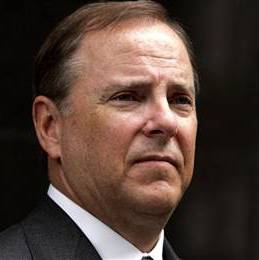
Skilling II at SCOTUS?

The Fifth Circuit Court of Appeals has not exactly distinguished itself in regard to its handling of the various appeals that emanated from the various Enron-related criminal prosecutions.

In particular, the Fifth Circuit recently denied former Enron CEO Jeff Skilling’s motion for a new trial even though Skilling’s theory of the case for a new trial was upheld by Fifth Circuit panels in two other Enron-related appeals.

So, per the motion below, Skilling is once again preparing to petition the U.S. Supreme Court to reverse the Fifth Circuit yet again and order the Fifth Circuit to issue a mandate to the U.S. District Court to give Skilling a new trial.

Frankly, as implicitly reflected by the prosecution’s agreement to a stay of the Fifth Circuit’s current mandate pending Skilling’s appeal to the U.S. Supreme Court, Skilling has a good case for a new trial. Stay tuned.

Jeff Skilling’s Motion to Stay Fifth Circuit Mandate Pending Appeal to U.S. Supreme Court

How to win this particular war

War on TerrorIn the context of the ten-year anniversary of the 9/11 attacks, Spencer Ackerman reminds us of the point that James Fallows and others have been making for over five years – the most effective way to defeat terrorism is to refuse to be terrorized:

In case you haven’t noticed, hysteria is what the terrorists want. In fact, it’s the only win a decapitated, weakened al-Qaida can get these days. The only hope that these eschatological conspiracy theorists possess for success lies in compelling the U.S. to spend its way into oblivion and pursue ill-conceived wars. That’s how Osama bin Laden transforms from a cave-dwelling psycho into a world-historical figure — not because of what he was, but because of how we reacted to him.

And that points to the only way out of a trap that’s lasted a decade. It has nothing to do with national security and everything to do with politics. The U.S. has to embrace the reality that terrorism is not anything remotely like the existential threat we make it out to be. We can honor those 2,996 without being permanently haunted by them.[.  .  .]

The risk, in other words, is a political risk. The culture of fear: It’s a bipartisan race to the bottom. And it’s why the National Security State constructed by the George W. Bush administration has found a diligent steward in President Obama. Asked recently if the post-9/11 security apparatus might diminish soon now that al-Qaida looks weak, Janet Napolitano, the secretary of homeland security, replied, “No.” [.  .  .]

Only when citizens make it acceptable for politicians to recognize that the threat of terrorism isn’t so significant can the country finally get what it really needs, 10 years later: closure.

Read the entire piece. That citizens still have to endure such outrages as security theater reinforces the truth of what Ackerman writes.

The Forger

In Bloodlands (Basic 2010), Timothy Snyder provides an extraordinary analysis of the human cost of the tyrannical regimes of Nazi Germany and the Soviet Union. Sarah Kaminsky’s father lived during those times and understood that cost. Ms. Kaminsky in the video below explains how her father figured out a way to reduce it.

Opening Night, Apogee Stadium, University of North Texas

Apogee Stadium

From the top

Ben Hogan’s swing from the top of the backswing.

Technological overload in the cockpit

airfrance447This Chris Sorensen/Macleans.CA article provides an excellent overview of an issue that is of interest to all air travelers – that is, the increasing number of loss-of-control airline accidents over the past five years:

Statistically speaking, modern avionics have made flying safer than ever. But the crash of [Turkish] Flight 1951 is just one of several recent, high-profile reminders that minor problems can quickly snowball into horrific disasters when pilots don’t understand the increasingly complex systems in the cockpit, or don’t use them properly. The point was hammered home later that year when Air France Flight 447 stalled at nearly 38,000 feet and ended up crashing into the Atlantic, killing all 228 on board.  .  .  [. . .]

Why is it happening? Some argue that the sheer complexity of modern flight systems, though designed to improve safety and reliability, can overwhelm even the most experienced pilots when something actually goes wrong. Others say an increasing reliance on automated flight may be dulling pilots’ sense of flying a plane, leaving them ill-equipped to take over in an emergency. Still others question whether pilot-training programs have lagged behind the industry’s rapid technological advances.

It’s a vexing problem for airlines, and a worrisome one for their customers. Unlike mechanical failures that can be traced to flawed design or poor maintenance, there is no easy fix when experienced and highly trained pilots make seemingly inexplicable decisions that end with a US$250-million airplane literally falling out of the sky. “The best you can do is teach pilots to understand automation and not to fight it,” [flight simulation expert Sunjoo] Advani says, noting that the focus in recent years has, perhaps myopically, been on simplifying and speeding up training regimes, secure in the knowledge that planes have never been smarter or safer. “We’ve worked ourselves into a little bit of a corner here. Now we have to work ourselves back out.”

Read the entire article. And then have a stiff drink before you get on your next commercial flight.

On unintended consequences

“A cunning tax on everyone else”

government_bailout1-260x223If you don’t read anything else this Labor Day weekend, check out this Nassim Taleb/Mark Spitznagel op-ed on the impact of dubious government bailout of Wall Street and big banks over the past several years:

For the American economy – and for many other developed economies – the elephant in the room is the amount of money paid to bankers over the last five years. In the United States, the sum stands at an astounding $2.2 trillion. Extrapolating over the coming decade, the numbers would approach $5 trillion, .  .  . That $5 trillion dollars is not money invested in building roads, schools and other long-term projects, but is directly transferred from the American economy to the personal accounts of bank executives and employees.

Such transfers represent as cunning a tax on everyone else as one can imagine. It feels quite iniquitous that bankers, having helped cause today’s financial and economic troubles, are the only class that is not suffering from them – and in many cases are actually benefiting.

As I’ve been saying for years, it’s not rocket science.